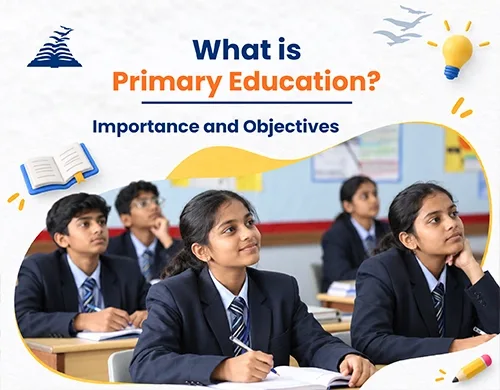
A child’s first years in school are about much more than learning to read, write or solve sums. They are the years when curiosity grows, friendships begin, routines are formed and children gradually learn how to understand the world around them. This makes primary schooling one of the most important stages in a child’s educational journey.
Understanding what is primary education helps parents see why these early school years deserve careful attention. The experiences children gain during this stage often shape their confidence, learning habits and attitude towards education for years to come.
Table of Contents
What Is Primary Education?
The definition of primary education generally refers to the first formal stage of schooling after preschool or early childhood education. During these years, children develop fundamental academic abilities while also learning communication, cooperation, responsibility and problem-solving.
The primary education meaning extends beyond textbooks and examinations. A good primary programme encourages children to ask questions, communicate ideas, develop healthy habits and become increasingly independent learners.
What Are the Different Stages of Primary Education?
Primary schooling may be organised slightly differently depending on the education board or school structure. Broadly, children progress from foundational learning towards increasingly structured lessons in languages, mathematics, science, environmental studies and social studies.
As students move through these years, lessons gradually become more detailed. Classroom activities may include reading, group discussions, projects, experiments, art, sports and hands-on learning to support different ways of understanding concepts.
Which Classes Are Included in Primary Education?
In many Indian schools, the primary stage commonly includes Classes 1 to 5. Some educational frameworks may describe the early years using slightly different stages, but the central purpose remains the same: building strong foundational skills before children enter middle school.
Parents searching for the best primary schools in Bangalore can consider factors such as teaching methods, class environment, student support, opportunities beyond academics and how effectively the school encourages age-appropriate learning.
Why Is Primary Education Important for Children?
The importance of primary education lies in the foundation it creates for everything children learn later. When students understand basic concepts clearly and develop positive study habits early, they are generally better prepared to handle more complex subjects in higher classes.
Primary school also introduces children to routines such as completing tasks, working in groups, following instructions and managing time. These everyday experiences gradually build confidence and independence.
Builds Strong Literacy and Numeracy Skills
Reading, writing and mathematics form the core of early learning. Children learn to recognise words, understand sentences, express ideas in writing and work confidently with numbers.
Strong foundational skills make it easier for children to understand subjects such as science, social studies and mathematics as they progress through school.
Supports Social and Emotional Development
School gives children opportunities to interact with classmates, share, cooperate and resolve small disagreements. These experiences help them understand emotions and develop empathy.
The significance of primary education can therefore be seen not only in academic progress but also in the way children learn to communicate, build friendships and become comfortable in social environments.
Encourages Creativity and Critical Thinking
Young children naturally ask questions. Primary education can nurture this curiosity through storytelling, experiments, puzzles, discussions, art and activity-based learning.
Rather than simply memorising information, children should gradually learn to observe, compare, question and find solutions independently.
What Are the Main Objectives of Primary Education?
The objectives of primary education include helping children acquire essential academic knowledge while developing communication skills, confidence, values, creativity and responsible behaviour.
Primary education should also encourage curiosity and make learning enjoyable so that children develop a positive attitude towards school.
Building a Strong Foundation for Lifelong Learning
Concepts introduced in primary classes become the building blocks for future subjects. Reading comprehension, numerical ability and communication skills continue to influence learning throughout secondary school and beyond.
This explains the role of primary education in preparing children not simply for the next examination but for continuous learning throughout life.
Developing Independence, Values and Responsibility
Children gradually learn to organise their belongings, complete assignments, follow routines and take responsibility for simple tasks. They also learn values such as honesty, kindness, respect and cooperation.
Such experiences help children become more self-reliant while understanding that their actions can affect the people around them.
How Primary Education Supports a Child’s Holistic Development
A balanced primary education gives attention to academics as well as physical, emotional, creative and social development. Sports, music, art, storytelling and collaborative activities allow children to explore strengths that may not always appear in conventional classroom tasks.
The benefits of primary education are therefore wider than academic achievement. Children can develop confidence, communication, creativity, discipline and the ability to work with others.
Role of Teachers and Parents in Primary Education
Teachers make difficult ideas easier to understand, observe individual learning needs and create an encouraging classroom environment. Their feedback can help children improve without becoming afraid of making mistakes.
Parents also play an important role by encouraging reading, maintaining regular routines and showing interest in what their child learns. Families considering top CBSE Schools in Bangalore can also look at how effectively schools encourage parent-teacher communication during the primary years.
How Primary Education Prepares Children for Future Learning
Primary school gradually teaches children how to learn independently. They begin to read instructions, organise information, complete projects, ask meaningful questions and apply concepts in different situations.
Families exploring schools in Bilekahalli may consider how primary programmes prepare children for the transition into middle school through strong academics, experiential learning and opportunities for overall development.
A strong beginning can make future learning feel less intimidating. When children leave primary school with sound fundamentals, confidence and curiosity, they are better equipped to adjust to more advanced subjects and greater academic responsibilities.
Presidency School Bangalore South: Building the Foundations for Lifelong Learning
Primary education is the stage where children develop the academic, social, emotional, and practical skills that shape their future learning journey. At Presidency School Bangalore South, the primary years are designed to strengthen literacy, numeracy, communication, creativity, curiosity, and problem-solving through engaging classroom experiences and age-appropriate activities. The focus goes beyond completing the syllabus, encouraging students to ask questions, work independently, collaborate with peers, and develop positive learning habits from an early age. By combining strong academic foundations with values, confidence-building, and holistic development, Presidency School Bangalore South helps young learners grow into capable, curious, and enthusiastic students prepared for the next stages of education.
Conclusion
Primary education is where children begin turning curiosity into understanding and everyday experiences into lasting learning habits. These early years build far more than literacy and numeracy; they also shape confidence, independence, communication, responsibility, creativity and social awareness. The importance of primary education therefore lies in creating a strong academic and personal foundation that supports every stage of learning that follows. Teachers and parents both contribute to this process by offering guidance, encouragement and consistent support. When children experience engaging lessons, positive relationships and opportunities to explore their interests, they are more likely to enter the next phase of schooling with stronger fundamentals, greater confidence and a genuine willingness to keep learning.