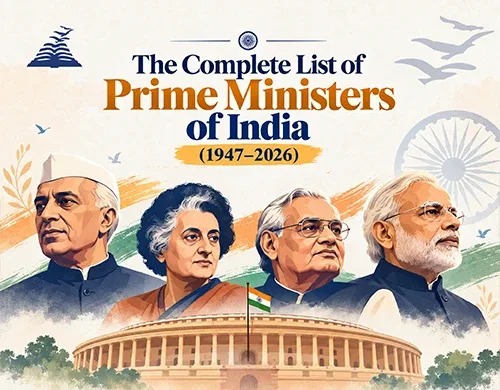
India’s prime minister leads the Union government and plays a central role in shaping national policy. Since Independence, the office has been held by leaders from different parties and political coalitions. This guide traces the Prime Ministers of India from Jawaharlal Nehru to Narendra Modi, with key dates and party affiliations.
Table of Contents
Chronological List of Prime Ministers of India
The List of Prime Ministers of India includes acting tenures, short-lived governments and leaders who returned to office. Some of the date ranges in the sections below group together more than one administration, so refer to the tenure table for each prime minister’s exact dates. The official Prime Minister’s Office lists these terms individually.
1947–1964: Jawaharlal Nehru
Jawaharlal Nehru became independent India’s first prime minister on 15 August 1947 and served until 27 May 1964. His tenure covered the early years of the republic and remains the longest continuous term in the office. He was a leader of the Indian National Congress.
1964–1966: Gulzarilal Nanda and Lal Bahadur Shastri
After Nehru’s death, Gulzarilal Nanda served as acting prime minister from 27 May to 9 June 1964. Lal Bahadur Shastri then took office, serving until 11 January 1966. Nanda again served as acting prime minister, from 11 to 24 January, before Indira Gandhi succeeded him.
1966–1977: Gulzarilal Nanda and Indira Gandhi
This heading spans the transition that began in 1966: Nanda’s second acting term ended on 24 January, when Indira Gandhi became prime minister. She served until 24 March 1977. The dates help distinguish Nanda’s brief caretaker role from Gandhi’s longer administration.
1977–1980: Morarji Desai and Charan Singh
Morarji Desai, of the Janata Party, served from 24 March 1977 to 28 July 1979. Charan Singh then became prime minister, leading a government that lasted until 14 January 1980. Indira Gandhi returned to office that day.
1980–1989: Indira Gandhi and Rajiv Gandhi
Indira Gandhi served from 14 January 1980 until her assassination on 31 October 1984. Rajiv Gandhi was sworn in the same day and remained prime minister until 2 December 1989. This period includes two successive Congress administrations.
1989–1991: V. P. Singh and Chandra Shekhar
V. P. Singh served from 2 December 1989 to 10 November 1990. Chandra Shekhar followed, holding office until 21 June 1991. Their governments came during a period of political change and shifting parliamentary support.
1991–1998: P. V. Narasimha Rao, Atal Bihari Vajpayee, H. D. Deve Gowda and I. K. Gujral
P. V. Narasimha Rao served from 21 June 1991 to 16 May 1996. Atal Bihari Vajpayee held office briefly from 16 May to 1 June 1996, followed by H. D. Deve Gowda and I. K. Gujral. Their terms ended on 21 April 1997 and 19 March 1998, respectively.
1998–2004: Atal Bihari Vajpayee
Vajpayee returned to office on 19 March 1998 and served until 22 May 2004. He led governments under the National Democratic Alliance (NDA), including a coalition that completed a full five-year term.
2004–2014: Dr. Manmohan Singh
Dr. Manmohan Singh served two consecutive terms, from 22 May 2004 to 26 May 2014, as a member of the Indian National Congress and leader of the United Progressive Alliance (UPA) government.
2014–2026: Narendra Modi
Narendra Modi became prime minister on 26 May 2014 and began a third consecutive term on 9 June 2024. As of 2026, he remains in office. He is a member of the Bharatiya Janata Party (BJP) and leads the NDA government.
Prime Ministers of India with Their Tenures and Political Parties
Here is an Indian Prime Ministers list with each period of service shown separately. Gulzarilal Nanda and Atal Bihari Vajpayee appear twice because each held office in separate terms.
| Prime Minister | Tenure | Party or political affiliation |
| Jawaharlal Nehru | 15 Aug 1947–27 May 1964 | Indian National Congress |
| Gulzarilal Nanda | 27 May–9 Jun 1964 | Indian National Congress |
| Lal Bahadur Shastri | 9 Jun 1964–11 Jan 1966 | Indian National Congress |
| Gulzarilal Nanda | 11–24 Jan 1966 | Indian National Congress |
| Indira Gandhi | 24 Jan 1966–24 Mar 1977 | Indian National Congress |
| Morarji Desai | 24 Mar 1977–28 Jul 1979 | Janata Party |
| Charan Singh | 28 Jul 1979–14 Jan 1980 | Janata Party (Secular) |
| Indira Gandhi | 14 Jan 1980–31 Oct 1984 | Indian National Congress |
| Rajiv Gandhi | 31 Oct 1984–2 Dec 1989 | Indian National Congress |
| V. P. Singh | 2 Dec 1989–10 Nov 1990 | Janata Dal |
| Chandra Shekhar | 10 Nov 1990–21 Jun 1991 | Samajwadi Janata Party (Rashtriya) |
| P. V. Narasimha Rao | 21 Jun 1991–16 May 1996 | Indian National Congress |
| Atal Bihari Vajpayee | 16 May–1 Jun 1996 | Bharatiya Janata Party |
| H. D. Deve Gowda | 1 Jun 1996–21 Apr 1997 | Janata Dal |
| I. K. Gujral | 21 Apr 1997–19 Mar 1998 | Janata Dal |
| Atal Bihari Vajpayee | 19 Mar 1998–22 May 2004 | Bharatiya Janata Party |
| Dr. Manmohan Singh | 22 May 2004–26 May 2014 | Indian National Congress |
| Narendra Modi | 26 May 2014–present | Bharatiya Janata Party |
Longest-Serving Prime Ministers in India
Jawaharlal Nehru served for about 16 years and nine months, from Independence in 1947 until his death in 1964. In June 2026, the Union Cabinet announced that Modi had passed Nehru’s record for the longest continuous service as an elected prime minister across consecutive terms, measured from 1952 to 1964. These records use different starting points, so it is useful to specify which measure is meant.
The Complete List of Prime Ministers of India (1947–2026): How Presidency School Bangalore South Brings History to Life
Understanding India’s political journey through its Prime Ministers, from Jawaharlal Nehru’s foundational leadership to the present day, is a vital part of civic and historical education, and Presidency School Bangalore South ensures students grasp this rich timeline with clarity and genuine interest. Through well-structured social science lessons, timeline charts, and classroom discussions, students explore the contributions, challenges, and historical context surrounding each era of leadership that has shaped modern India.
Rather than reducing this to rote memorization of names and dates, the school’s faculty contextualizes key policies, milestones, and turning points, helping students connect historical events to present-day civic awareness. Interactive quizzes, current affairs discussions, and project-based learning further deepen this understanding across grade levels. For parents in Bangalore South looking for thebest CBSE Schools in Bilekahalli that builds informed, civic-minded students alongside strong academics, Presidency School Bangalore South remains a trusted and engaging educational choice.
Conclusion
India’s list of prime ministers reflects far more than a sequence of names and dates — it traces the arc of a democracy that has navigated independence, partition, economic transformation, coalition politics, and two full generations of change in governance and national identity. From Nehru’s foundational nearly 17-year tenure to the political turbulence of the late 1980s and 1990s, and through to the sustained BJP-led administrations of the 21st century, each prime minister has left a distinct imprint on the country’s direction.
For students studying Indian history, understanding this chronology — who served when, under which party, and during which era of national events — builds the contextual framework that makes broader political and economic history far more coherent. The tenure table is a reference; the real learning lies in connecting each administration to the circumstances that shaped it.
Whether preparing for competitive exams like UPSC, CUET, or school-level civics assessments, a firm grasp of India’s prime ministerial history is one of the most reliable foundations a student can build in the social sciences.