How to Learn India’s States and Capitals Easily at School
Learning India’s states and capitals is an important part of every student’s academic journey, especially for children studying in the best CBSE Schools in Bangalore, where Social Science and General Knowledge are taught with a strong focus on conceptual understanding. India is a diverse country with different cultures, languages, traditions, and regions, and knowing its states and capitals helps students understand the nation better.
Many students find it difficult to remember all the capitals and states at first because the names may seem long or unfamiliar. However, with the right learning methods, students can make this topic simple, enjoyable, and easy to recall during exams, quizzes, and classroom discussions.
Before learning state capitals, students should first know that New Delhi is the capital of India. Understanding this basic fact helps children connect national governance with state-level administration, making it easier to understand why each state has a capital city of its own.
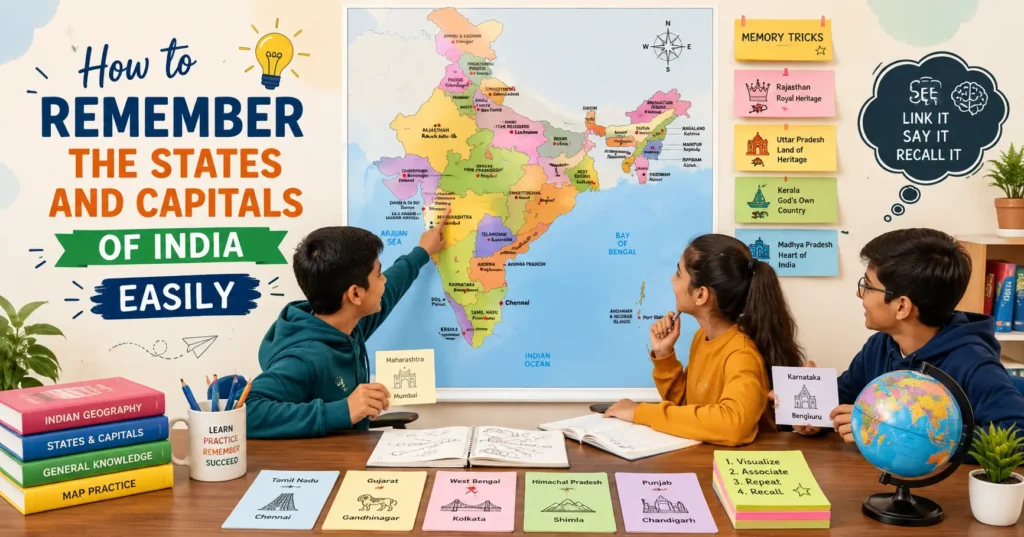
One of the most effective ways to learn this topic is through map practice. When students look at a political map of India and identify each state along with its capital, they develop better visual memory and understand the location of each region more clearly.
The list of states and capitals of India includes 28 states, each with its own administrative capital. These capitals are important centres where major government offices, decision-making bodies, and administrative activities are located.
Students should regularly revise Indian states and capitals by dividing them into smaller regional groups. For example, they can first learn the southern states, then move to the northern, western, eastern, central, and north-eastern regions of India.
Using an India map with states and capitals can make learning much more interesting. Students can colour different regions, mark capitals with dots, and label each state, turning memorisation into an engaging classroom or home activity.
Learning this topic also strengthens GK for students, as states and capitals are commonly asked in school exams, quiz competitions, entrance tests, and general awareness activities. It also helps students understand news, travel, culture, and national events more effectively.
For better revision, students can keep an India map with states and capitals on their study table or classroom wall. Seeing the map every day helps them remember locations naturally and improves their confidence in identifying states and capitals.
Many parents looking for top CBSE schools in Bangalore prefer institutions that make learning interactive and activity based. Schools that use maps, quizzes, worksheets, and smart classroom tools help students understand geography in a practical and enjoyable way.
The best schools in Bangalore focus not only on memorisation but also on helping students connect classroom lessons with real-world knowledge. When children learn states, capitals, cultures, languages, and important cities together, they develop a broader understanding of India.
Why Learning States and Capitals Is Important
Learning states and capitals helps students understand India’s political and administrative structure. Each state has a capital city that plays an important role in governance, planning, and development. When students know these capitals, they can better understand how different parts of the country function and contribute to national progress.
This knowledge is also useful in subjects such as Social Science, Geography, Civics, and Current Affairs. For example, when students hear about an event in Jaipur, Bhopal, Dispur, or Imphal, they can immediately connect the city to its respective state.
This makes learning more meaningful and practical. Knowing states and capitals also improves map-reading skills. Students begin to understand which states are located in the north, south, east, west, central, and north-eastern regions of India. This helps them visualise the country more clearly and remember information for a longer time.
List of Indian States and Capitals
| No. | State | Capital |
| 1 | Andhra Pradesh | Amaravati |
| 2 | Arunachal Pradesh | Itanagar |
| 3 | Assam | Dispur |
| 4 | Bihar | Patna |
| 5 | Chhattisgarh | Raipur |
| 6 | Goa | Panaji |
| 7 | Gujarat | Gandhinagar |
| 8 | Haryana | Chandigarh |
| 9 | Himachal Pradesh | Shimla |
| 10 | Jharkhand | Ranchi |
| 11 | Karnataka | Bengaluru |
| 12 | Kerala | Thiruvananthapuram |
| 13 | Madhya Pradesh | Bhopal |
| 14 | Maharashtra | Mumbai |
| 15 | Manipur | Imphal |
| 16 | Meghalaya | Shillong |
| 17 | Mizoram | Aizawl |
| 18 | Nagaland | Kohima |
| 19 | Odisha | Bhubaneswar |
| 20 | Punjab | Chandigarh |
| 21 | Rajasthan | Jaipur |
| 22 | Sikkim | Gangtok |
| 23 | Tamil Nadu | Chennai |
| 24 | Telangana | Hyderabad |
| 25 | Tripura | Agartala |
| 26 | Uttar Pradesh | Lucknow |
| 27 | Uttarakhand | Dehradun |
| 28 | West Bengal | Kolkata |
Easy methods to remember states and capitals of India
Let us understand about some of the tips that can be used to memorise the States & Capitals of India with some easy techniques mentioned below
Start with Regional Grouping
One of the easiest ways to learn India’s states and capitals is by grouping them according to regions. Instead of trying to memorise all 28 states at once, students can divide them into smaller groups. This reduces pressure and makes learning easier.
For example, students can begin with South India: Karnataka–Bengaluru, Kerala–Thiruvananthapuram, Tamil Nadu–Chennai, Telangana–Hyderabad, and Andhra Pradesh–Amaravati. Once this group is clear, they can move to North India, West India, East India, Central India, and the North-East.
Regional grouping helps students create a mental map. When they think of a region, they can remember the states within that area and connect each state with its capital. This method is especially useful for students who learn better through visuals and patterns.
Use Maps for Better Memory
A political map of India is one of the best tools for learning states and capitals. When students see the shape and location of each state, they remember the information more effectively. For example, locating Karnataka and then identifying Bengaluru as its capital makes learning more active.
Students can also use blank maps for practice. They can first mark the states, then write the capitals, and finally check their answers. This method improves both memory and accuracy. Regular map-based revision also helps students perform better in exams.
Teachers can make map learning more engaging through classroom activities. Students can be asked to identify a state, locate its capital, and share one interesting fact about it. This helps them connect geography with culture, history, and current affairs.
Learn Through Association
Association is a useful memory technique that helps students connect facts with familiar ideas. For example, Karnataka can be linked with Bengaluru, known as India’s technology hub. Maharashtra can be linked with Mumbai, known for finance and cinema.
Similarly, Rajasthan can be remembered with Jaipur, the Pink City, while West Bengal can be connected with Kolkata, known for literature and culture. Kerala’s capital,
Thiruvananthapuram, may be easier to remember when students connect it with the southern coastal region.
When students attach meaning to names, they remember them better. Instead of memorising random words, they begin to see capitals as real places with identity, history, and importance.
Use Flashcards for Quick Revision
Flashcards are a simple and effective way to practise states and capitals. Students can write the name of a state on one side and its capital on the other. By testing themselves regularly, they can improve recall and confidence.
For example, one card may have “Gujarat” on one side and “Gandhinagar” on the other. Another may have “Odisha” and “Bhubaneswar.” Students can revise these cards every day for a few minutes.
Flashcards are especially useful because they make revision quick and focused. Parents can also use them at home to conduct short quizzes in a fun and relaxed manner.
Create Mnemonics and Memory Tricks
Mnemonics help students remember information creatively. Students can create short phrases, rhymes, or stories using the first letters of states and capitals. These tricks are helpful for remembering difficult names and spellings.
The north-eastern states can be learned together as a group: Arunachal Pradesh–Itanagar, Assam–Dispur, Manipur–Imphal, Meghalaya–Shillong, Mizoram–Aizawl, Nagaland–Kohima, Sikkim–Gangtok, and Tripura–Agartala.
Students can also create funny sentences or short songs to remember groups of states. The more creative the method, the easier it becomes to recall the answer during exams or quizzes.
Make Learning Fun with Quizzes
Quizzes make learning exciting and interactive. Instead of simply reading the list again and again, students can test their knowledge through classroom quiz games, rapid-fire rounds, and map challenges.
Teachers can divide students into teams and ask questions such as, “What is the capital of Odisha?” or “Bhopal is the capital of which state?” Such activities create healthy competition and help students learn faster.
Parents can also conduct short quizzes at home. A few questions every day can help children revise regularly without feeling stressed. Small, consistent practice is more effective than last-minute memorisation.
Connect Capitals with Interesting Facts
Students can remember capitals better when they learn interesting facts about them. Bengaluru is known for technology, Mumbai for finance and films, Jaipur as the Pink City, Chennai for culture and industry, and Kolkata for literature and heritage.
These facts make learning more meaningful. Instead of seeing capitals as simple names, students begin to understand them as important cities with unique identities.
This builds curiosity and encourages students to learn more about India.
Teachers can also encourage students to prepare short presentations on different capitals. This helps them improve research, speaking, and presentation skills while learning geography.
How Presidency School Bangalore South Makes Learning India’s States and Capitals Easy, Engaging, and Unforgettable
Remembering the states and capitals of India becomes easier when students learn through simple, creative, and engaging methods instead of memorising everything at once. At Presidency School Bangalore South, students are encouraged to use maps, flashcards, quizzes, songs, memory tricks, group activities, and regular practice to make learning more enjoyable and effective.
By connecting each state with its location, culture, language, or famous landmark, children can retain information better and build a stronger understanding of India’s geography. With interactive classroom learning and supportive teacher guidance, Presidency School Bangalore South helps students develop confidence, curiosity, and a lasting interest in learning about the country.
Conclusion
Learning India’s states and capitals becomes easy when students use the right techniques. Maps, flashcards, quizzes, mnemonics, songs, writing practice, and regional grouping can make the process simple and enjoyable.
This topic is not only useful for exams but also helps students understand India’s geography, governance, culture, and diversity. With regular practice, students can master states and capitals confidently. By learning in a structured and creative way, children develop stronger General Knowledge and a deeper connection with the country. With the support of teachers and parents, every student can learn India’s states and capitals with confidence and interest.